

Tractor and Trailer: Types, Operation, and Differences
Everything you need to know about tractors and trailers: structural differences, body configurations, and how to optimize every journey.
What is a Tractor and How Does It Work?
The tractor is the main vehicle, equipped with an autonomous engine and driver’s cab, designed to move independently and tow one or more load units.
It represents the active component of the convoy, responsible for propulsion, combined braking, and steering.
Its features include:
Autonomous propulsion: High-power, high-torque engines designed to move heavy loads on urban, intercity, and international routes.
Driver’s cab: The operator’s workspace, equipped with vehicle controls and monitoring systems for the towed load.
Coupling systems: Mechanical, pneumatic, and electrical devices (tow hook/drawbar coupling or fifth wheel) that transmit drive power, compressed air for the brakes, and electrical power for the rear unit's lights.
Variable payload: Sized according to the number of axles and the authorized maximum gross vehicle weight.
Tractor vs. Road Tractor Unit: A Technical Distinction
In everyday language, they are often used interchangeably, but a precise structural difference exists:
The tractor: Features its own chassis with a cargo area (such as a fixed or curtainside body) and can tow a trailer via a drawbar and coupling.
The road tractor unit (semi-truck / prime mover): Does not carry cargo directly on its structure; it only features a platform fitted with a fifth-wheel coupling onto which a semi-trailer rests and attaches.
All road tractor units fall under the category of towing/motor vehicles, but not all tractors are fifth-wheel road tractor units.
What is a Trailer and What Are the Main Types?
A trailer is a passive transport unit without an engine of its own, designed to house cargo and be towed by a motorized vehicle.
Unable to move independently, it relies entirely on the towing vehicle for traction, auxiliary braking systems, and lighting signals.
Depending on axle configuration and cargo type, several variants are distinguished:
Drawbar trailer (traditional trailer): Equipped with at least two axles (one steering front axle and one or more rear axles) and transfers its entire weight directly to the ground. It attaches to the tractor via an articulated drawbar, forming a road train.
Semi-trailer: Lacks a front axle and transfers a significant portion of its weight directly onto the fifth wheel of the road tractor unit, forming an articulated vehicle (semi-truck).
Specific body types: Depending on the type of cargo, load units can be:
Curtainsiders: Equipped with sliding tarpaulins to facilitate side loading and protect goods from bad weather;
Isothermal or refrigerated: For perishable goods and temperature-controlled food products;
Tankers: For bulk liquids, gases, or powders;
Tippers (dump trailers): Ideal for aggregates and construction site materials;
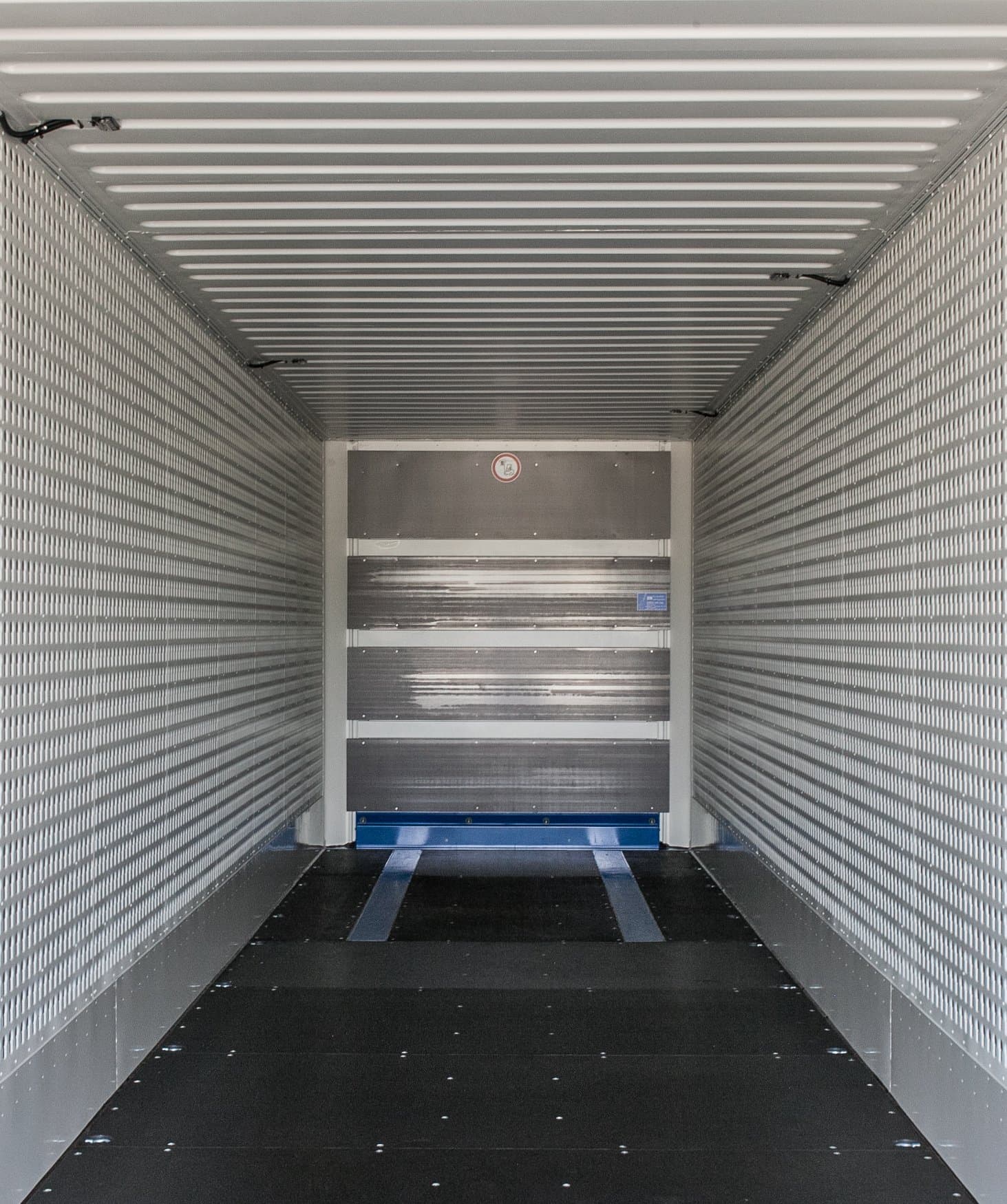
Box trailers (dry vans): Featuring rigid walls, suitable for interior garment rails for hanging garments, ideal for the fashion and apparel sector;
Flatbeds (open platforms): Open-deck trailers used for oversized goods, bulky machinery, or out-of-gauge heavy haulage;
Coil carriers: Designed to transport steel coils and cylindrical loads safely, featuring a recessed central well in the floor ("coil well") that cradles and stabilizes the coil.
Differences Between Tractor and Trailer
Feature | Tractor | Trailer / Semi-Trailer |
Role | Active (propulsion and steering) | Passive (load support) |
Engine | Integrated, autonomous | None |
Driver's cab | Present | None |
Road autonomy | Can travel independently | Strictly requires a towing vehicle |
Connection | Supplies power, air, and electricity | Receives power and pneumatic control |
Clearly distinguishing these two components is essential to:
Accurately calculate weight limits: Respect maximum axle load limits and the gross combination weight rating (GCWR).
Plan load distribution: Distribute weight evenly between drive axles and passive axles to prevent imbalance.
Types of Tractors for Freight Transport
Configurations vary according to operating range and cargo characteristics:
2-axle tractor: Compact and maneuverable, ideal for regional distribution, medium-haul transport, and urban logistics where maneuvering space is tight.
3-axle tractor (or more): Equipped with an additional axle (often liftable or self-steering), offering higher stability, lower road wear, and significantly greater load capacity suited for heavy industrial cargo.
Curtainside tractor: Built with uprights and sliding side curtains, combining top/side loading convenience with general freight flexibility for pallets and standard packages.
Box tractor with tail lift: Ideal for goods requiring protective rigid walls and for delivery points lacking an industrial loading dock.
When to Use the Tractor-Trailer Combination
Pairing a tractor with a trailer (or a road tractor unit with a semi-trailer) forms the backbone of modern logistics for efficiency and operational sustainability:
High volumes and heavy loads: Reaches up to 40–44 tonnes of gross vehicle weight (depending on local regulations), maximizing efficiency per trip.
Logistical flexibility: On long-haul or intermodal routes, the motorized vehicle can drop off a loaded trailer at its destination and immediately hitch an already loaded return unit, cutting downtime and optimizing driver hours.
Modular adaptability: Allows operators to alternate body styles (a tanker one day, a curtainsider the next) using the same power unit.